
 Shop
Shop


Knowledge
Water and Moisture Absorption
Water and Moisture Absorption
Water absorption and moisture absorption is a very common and common property in plastics, the natural environment is full of water vapor, after the plastic absorbs its moisture, it will cause many property changes, the most obvious of which is the increase in weight and size, this characteristic is called Water Absorption, also known as Moisure Absorption, is a reversible effect.
In principle, water absorption and moisure absorption are the same, both are about the ability of materials to absorb water, if you want to distinguish them, you can distinguish them as follows:

Water Absorption–
Emphasis is placed on contact with water or immersion in water, and the absorption time is short.
Moisture Absorption–
It emphasizes contact with water vapor in the air and has a long absorption time.
How do you calculate Water Absorption?
The test standard for plastic water absorption is based on ASTM D570, and there are three methods
- Test pieces were soaked in distilled water for 24 hours at 23°C (73.4°F)
- Test for 24 hours, how much water absorption in water will increase.
- The test piece is immersed in distilled water until the water absorption change stops or no longer rises. [Recommended to heat to 100°C]
- The test is full, and the water absorption is maximum.
- The test piece was placed in ambient air for 24 hours, at a temperature of 23°C (73.4°F), and a humidity of 50%.
- Test the balance to see how much the water absorption rate increases in the air for 24 hours

What are the effects?
Process
Before injection molding, the material particles need to be dried and dried to completely remove the moisture before entering the injection molding machine to avoid water evaporation and vaporization, resulting in product defects, such as silver marks and bubbles.
Some plastic materials, the water absorption rate is very low, but very sensitive to moisture, such as PET, often used in PET bottles, in the production process, only a little moisture, coupled with the high heat and high temperature of the machine, cause PET to be directly hydrolysis (Hydrolysis), which cannot be formed.
Product
Plastics absorb water, and the water absorbed will affect the performance in different ways according to the material compound, as follows:
- Size changes. Water absorption can cause the plastic to expand, changing its size, which can affect the fit of precision parts. The greater the water absorption, the larger the size.
- Weight changes. As plastic products absorb moisture, their weight increases. The greater the water absorption, the heavier the weight.
- Mechanical properties. Water absorption affects the mechanical properties of plastics, such as: elasticity, tensile, impact, wear.
- Electrical performance. Once the plastic product has moisture in it, it reduces the electrical insulation, and special attention should be paid to the application with this demand.
Water absorption rate of common plastic materials
Considering the Moisture absorption of these plastic materials under different environmental conditions can help you make a more appropriate decision when choosing and using plastic materials.
- Nylon (PA): Nylon is a highly hygroscopic material, with a water absorption rate of up to 7-9%. Therefore, the mechanical properties of nylon can be significantly altered in humid environments.
- Polycarbonate (PC): Polycarbonate has moderate moisture absorption, with a water absorption rate of about 0.2-0.4%. Its dimensional stability will be affected to a certain extent, but the impact is less than that of nylon.
- Polyethylene (PE): Polyethylene is virtually absorbent, typically less than 0.01%. Therefore, it has excellent dimensional stability in wet environments.
- Polypropylene (PP): Polypropylene also has a very low water absorption rate, typically less than 0.02%. Its performance is largely unaffected in humid environments.
- Polyoxymethylene (POM): Also known as delrin, delrin has a low water absorption rate, usually around 0.2-0.3%.
- Polyvinyl chloride (PVC): Low water absorption, typically less than 0.04%.
These values can be used as a reference when selecting plastic materials, and if you have specific application scenarios or need detailed technical data, you can still find the data of water absorption of other related materials through queries, such as: Shrinkage Value of Plastics Material & Injection Molding – Chart
What is the local environment?
The environmental humidity in each country is different, and the average environmental humidity in Taiwan is more than 75% per year, which greatly affects the hygroscopicity of plastics, and must be often considered in various usage situations. For use environments with high humidity in water, choosing plastics with low water absorption may be better than other plastics.

What factors affect water absorption?
1. Material type
Different materials, different water absorption. For example, PC polycarbonate has a minimum water absorption rate of 0.1%, while PA46 nylon has a minimum water absorption rate of 1.3%, which is more than 10 times the difference between the two.
2. Additives
For example, fillers, anti-moisture powders, softeners, etc., according to the needs of molding, various elements will be added in, in order to obtain or strengthen a certain ability, but also produce other effects, example 1: plastic PVC adds softeners, increases elasticity, but the water absorption rate also increases. Example 2: PTFE itself is almost non-absorbent, but with the addition of fibers, the water absorption rate increases because there is only physical contact between the fibers and the material, and there are still subtle gaps.
3. Crystalline vs. non-crystalline
Although crystalline and amorphous materials are not directly related to water absorption, they present different results. After absorbing water, the dimensional performance of crystalline materials is relatively unstable; The dimensional performance of amorphous materials is relatively stable after absorbing water.
4. Fiber directionality
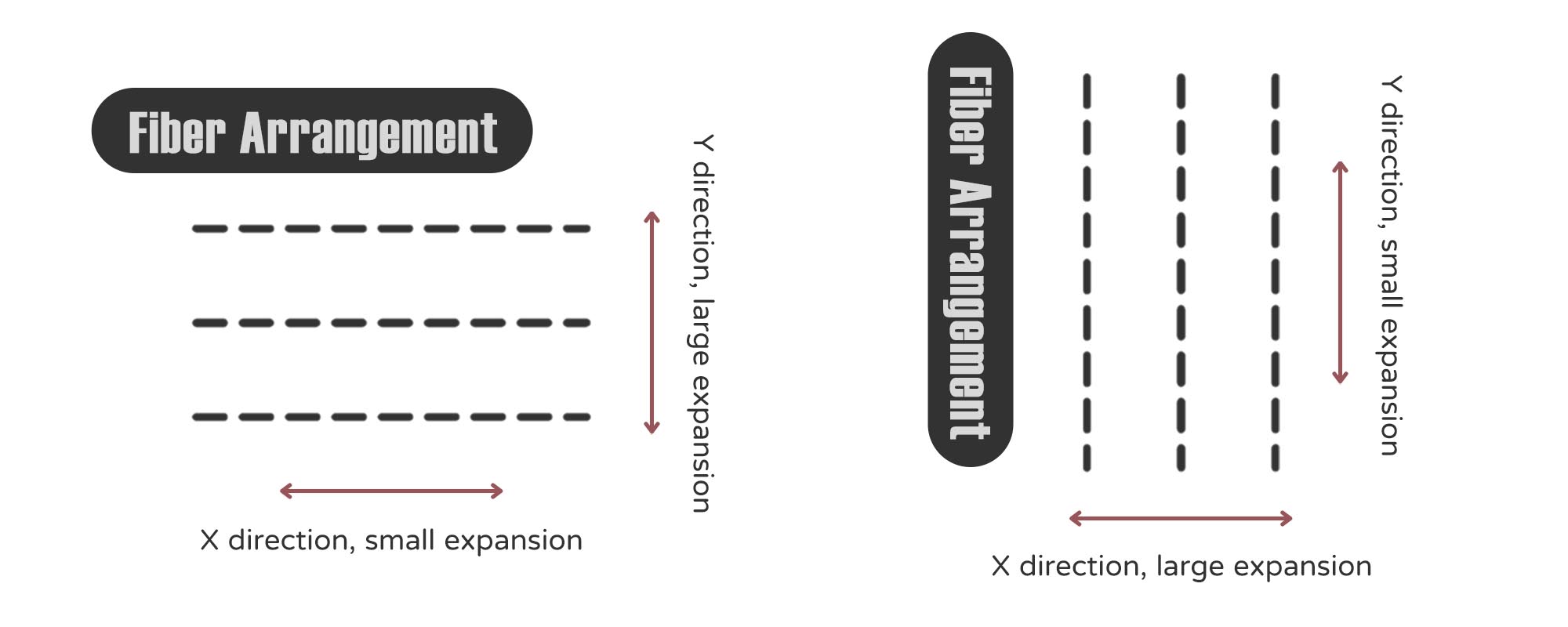
The fiber arrangement is parallel to the flow direction, and after water absorption, the transverse size (X) expands less and the longitudinal dimension (Y) expands more after water absorption. On the contrary, the fiber arrangement direction is perpendicular to the flow direction, and the expansion is larger in the transverse size (X) and less in the longitudinal size (Y).
5. Ambient humidity
The level of environmental humidity will affect the speed and fullness (harmony) of the material, and the water absorption rate will not rise endlessly, because the water will volatilize and the water absorption rate will reach a balance point. For example: POM has a water absorption rate of 0.10% at 50% ambient humidity and 0.30% at 90% ambient humidity.
6. Ambient temperature
Related to the environment, when the environmental medium is air, it is like human pores, the temperature rises, the pores open, the water volatilizes, and the water absorption rate decreases. When the environmental medium is water, the temperature rises to open the capillaries to store water and increase the water absorption rate.

7. Time of exposure to the environment
If the freshly formed product is placed in the environment for a longer time, the water absorption rate will gradually increase until it reaches a balance with the ambient humidity. For example, products that have been forced to absorb water and are fully absorbed will have the highest water absorption rate, but then gradually decrease over time until it reaches equilibrium with ambient humidity.

Forced water absorption
When the product is injection molded in the mold, there will be material shrinkage, which is the first size change, and then placed in the atmosphere, in contact with air and water vapor, due to moisture absorption and expansion, this is the second dimensional change, which is inevitable, when the balance with the ambient moisture is reached, the size change and performance also reach a stable state.
In order to reduce the waiting time, the product is forced to absorb water, and quickly achieve the desired purpose and the performance of the product, the method of forced water absorption will be adopted, such as adding water to boil and soaking water at room temperature.

How to apply?
For example, nylon has poor toughness and high hardness when drying, so the installation product is easy to crack; When nylon absorbs water, the hardness decreases and it is elastic, and the installation product is not easy to damage.
